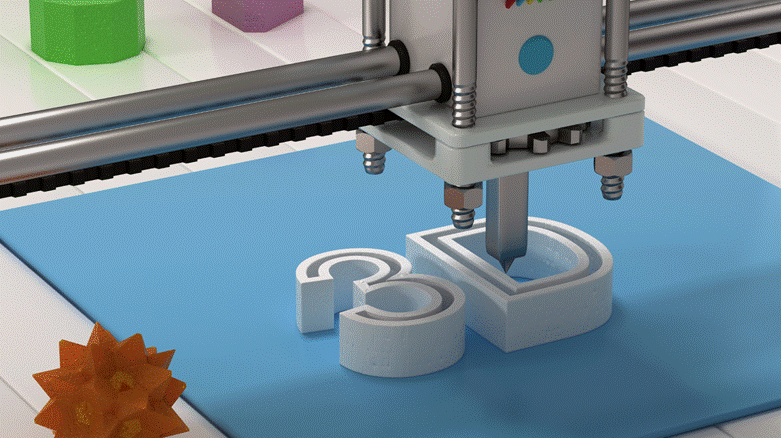
Supply chains are cracking under pressure. Costs are climbing, global disruptions keep arriving uninvited, and customers expect faster delivery than ever before. Something had to give. 3D printing supply chain integration has emerged as one of the most promising answers to these mounting challenges, and honestly, the momentum behind it is hard to ignore.
Shorter lead times, leaner inventories, smarter logistics. This post unpacks exactly how additive manufacturing is transforming supply chain operations, and what companies risk losing by sitting on the sidelines.
How 3D Printing Is Actually Changing Supply Chain Operations
This isn’t a slow, incremental shift. What’s happening in manufacturing right now is a genuine rethinking of how production should work. Traditional models, built for stability and scale, struggle to keep pace with the speed and flexibility today’s market demands. 3D printing efficiency is filling that gap in ways that are hard to argue with once you see the numbers.
Here’s a striking data point: only 20.2% of U.S. firms reported using 3D printing in 2024, meaning the vast majority of businesses haven’t yet touched its supply chain potential. That’s both surprising and, frankly, a significant opportunity for those willing to move first.
When it comes to 3D printing service providers, companies have set a compelling new benchmark, operating massive facilities like their 30,000 sq ft production floor, handling everything from early-stage prototyping to full production-grade parts. That kind of infrastructure shows just how scalable and practical this technology has become for real supply chain applications.
Faster Lead Times Through On-Demand Manufacturing
Remember waiting weeks for tooling or molds? That’s increasingly a thing of the past. Manufacturing on demand through additive technology means a part can travel from digital file to physical product in hours. Not weeks, hours.
Aviation companies are already printing replacement components on-site rather than waiting for overseas suppliers. Hospitals produce customized surgical guides in days instead of months. These aren’t pilot programs anymore. They’re standard operations. The 3D printing supply chain model simply eliminates several of the slowest steps traditional manufacturing depends on, and the time savings are real and measurable.
Untangling Complex, Multi-Tier Supply Chain Logistics
Multi-tier supply chains are notoriously fragile. One disruption upstream, and everything downstream grinds to a halt. You’ve probably seen this firsthand, or at minimum watched it play out across entire industries during recent global events. Additive manufacturing logistics addresses this fragility by decentralizing production, pulling manufacturing physically closer to where products are actually needed.
No more relying solely on distant suppliers and unpredictable shipping timelines. Components can be produced locally or regionally, reducing transportation bottlenecks and making just-in-time delivery genuinely achievable rather than aspirational. That’s a meaningful shift in how much control companies can actually exercise over their own supply risk.
Speed and leaner logistics are compelling on their own. But the real competitive advantage? Using 3D printing not just to move faster, but to think and respond smarter.
Building Real Flexibility Into Your Supply Chain
Supply chain flexibility is more than a buzzword. It means your operation can pivot quickly when conditions change, and conditions always change. That’s precisely where additive manufacturing earns its reputation. It isn’t locked into rigid tooling or fixed production volumes, which gives companies a level of responsiveness that traditional methods simply can’t match.
Responding Quickly to Market Shifts and Customization Needs
Digital inventory is gradually replacing physical stockrooms. Rather than warehousing thousands of components across multiple locations, companies maintain design files and print precisely what’s needed, exactly when it’s needed. No over-ordering. No guessing.
This approach supports regional product variants, spare parts fulfillment, and customer-specific customization, without the usual lead time penalties or overproduction headaches. 3D printing efficiency and supply chain flexibility genuinely reinforce each other here. They’re not separate benefits; they compound.
Cutting Inventory, Warehousing, and Obsolescence Costs
Printing on demand means carrying far less physical stock. Aerospace aftermarket teams, medical device manufacturers, and industrial equipment companies are all trimming warehousing costs by leaning into this model. Less floor space. Lower carrying costs. Fewer write-offs.
That last part is worth dwelling on. Obsolete inventory is an expensive problem that rarely gets the attention it deserves. When designs evolve, digital files update instantly. No shelves full of outdated parts. No painful inventory write-downs at year-end. Just cleaner, more responsive operations.
Strategic Applications: Distributed Manufacturing at Scale
This goes beyond individual use cases. large scale 3d printing is now influencing how forward-thinking organizations architect their entire global manufacturing networks. We’re talking about a structural evolution in supply chain design, not just a new tool in the toolbox.
And the industry data backs this up: 70% of businesses[1] produced more printed parts in 2023 than in 2022, reflecting a clear pivot from experimentation toward serious production volumes.
Distributed Manufacturing Networks as the New Standard
Forward-looking global brands are establishing regional 3D printing hubs, production nodes that can respond to demand wherever it emerges. This strategy eliminates long-haul shipping, shrinks exposure to geopolitical risk, and creates a resilience that centralized factories can’t offer. COVID-19 made this painfully obvious. Companies with distributed, additive-capable networks recovered faster. Full stop.
Environmental Benefits That Actually Add Up
Localized production through additive manufacturing logistics meaningfully reduces transportation emissions. Fewer shipments. Smaller carbon footprint. Additive processes also generate substantially less material waste than subtractive methods, which aligns well with the circular economy commitments many companies are now actively working toward rather than just talking about.
| Factor | Traditional Manufacturing | 3D Printing / Additive |
| Lead Time | Weeks to months | Hours to days |
| Inventory Needs | High physical stock | Digital files, print on demand |
| Customization | Expensive, slow | Fast, cost-effective |
| Waste Generated | High (subtractive methods) | Minimal |
| Supply Chain Risk | High dependency | Distributed, resilient |
Frequently Asked Questions
How does 3D printing reduce supply chain risk?
By enabling distributed, on-demand production, companies reduce dependence on single suppliers and long shipping routes. Local manufacturing hubs respond quickly to disruptions, keeping production moving even when traditional supply chains face serious pressure.
Is additive manufacturing only useful for prototypes?
Not remotely. Many industries now use it for end-use production parts. Aerospace, medical, and automotive sectors regularly print functional components that go directly into finished products, not just early-stage models sitting in a lab.
Which industries benefit most?
Aerospace, healthcare, automotive, and industrial equipment see the strongest gains. These sectors deal with complex parts, strict customization requirements, and high costs associated with excess or obsolete inventory, exactly the pain points that additive manufacturing addresses best.
Where This Leaves You
3D printing supply chain integration isn’t a future-state concept anymore. It’s happening right now, across some of the most demanding industries in the world. From cutting lead times to eliminating unnecessary inventory, additive manufacturing is fundamentally changing how goods are designed, made, and delivered. Supply chain flexibility, additive manufacturing logistics, and manufacturing on demand are converging into something more resilient and more intelligent than what most operations look like today. Companies that explore these opportunities now, seriously, not just theoretically, will be far better positioned when the next disruption arrives. And it will arrive.
@[email protected] competitor
_Assigned to [email protected]_
