There is a predictable sequence in a vape shop. A smoker switching over asks for a tobacco flavour, on the entirely reasonable assumption that replacing a cigarette means replacing its taste. They buy one, try it, and are disappointed. They try a different brand, are disappointed again, and conclude that vaping does not work.
What has gone wrong is not the product. It is that the request was impossible from the start, for reasons that have nothing to do with how much effort the manufacturer put in.
This is worth explaining properly, because the people it affects are precisely the people most at risk of going back to cigarettes.
The thing you are asking for is a product of burning, and nothing is burning.
What a Cigarette Actually Tastes Of
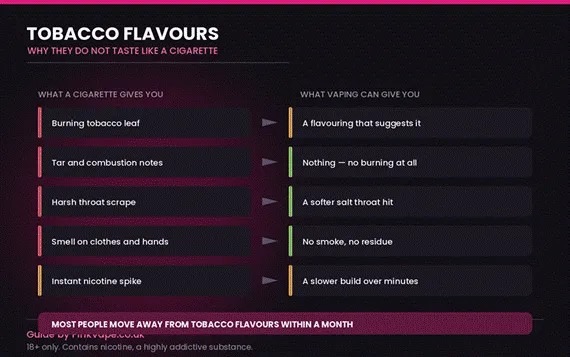
Here is the crux. The taste of a cigarette is overwhelmingly the taste of combustion, not of tobacco.
Burning organic material at several hundred degrees produces thousands of compounds that did not exist in the leaf beforehand. Tar, phenols, aldehydes, the products of incomplete combustion — those are what create the characteristic flavour, the harshness at the back of the throat, and the smell that clings to clothing.
Unburnt tobacco tastes almost nothing like a lit cigarette. Anyone who has smelled a fresh pouch of pipe tobacco and then a full ashtray has experienced how different the two are.
Vaping involves no combustion. There is no burning, no tar and none of those thousands of compounds — which is the entire health argument for switching, and simultaneously the reason the flavour cannot be reproduced. You cannot have the taste of burning without the burning.
What Tobacco E-Liquid Is Actually Doing
Manufacturers are working with food-grade flavourings to suggest something the ingredients cannot literally produce. What they generally aim at is the impression of tobacco rather than the reality of smoke.
• Sweet or ‘RY4’ style: tobacco notes with caramel and vanilla. Pleasant, popular, and nothing like a cigarette.
• Dry or ‘classic’ style: closer to unburnt leaf, sometimes slightly nutty or woody.
• Blended: tobacco with menthol, coffee or cream, which works better precisely because it is not pretending.
The better ones are genuinely enjoyable flavours. They are simply not cigarettes, and judging them against a cigarette guarantees disappointment.
What Actually Replaces the Cigarette
If flavour cannot do it, something else has to. Three things carry most of the weight, and getting them right matters far more than the taste.
1. Nicotine strength matched to your habit. This is the single biggest factor. Twenty milligrams of salt for a heavier smoker; ten for a lighter one. Undershooting here is why most switches feel unsatisfying.
2. A tight mouth-to-lung draw. The physical action of drawing against resistance is a large part of what your body is expecting.
3. Throat hit. Nicotine salts provide a definite catch at the back of the throat — not identical to smoke, but occupying the same space.
Get those three right with a flavour you actively enjoy, and the absence of a tobacco taste stops mattering within a fortnight. Get them wrong with a perfect tobacco flavour and you will still be reaching for cigarettes.
What to Buy Instead
The practical recommendation for a switching smoker is to pick a flavour you would enjoy on its own terms rather than one that reminds you of smoking. Most people land on mint, menthol or an iced fruit, all of which provide a clean sensation that suits the transition. Browsing a an established UK retailer by flavour family rather than by what sounds most cigarette-like is a better use of the first purchase.
• Menthol smokers: start with mint or menthol, which genuinely does replicate something specific.
• Everyone else: an iced fruit is the safest first choice — broadly appealing and resistant to palate fatigue.
• If you want to try tobacco, buy it as a second flavour rather than your only one.
• Blended tobacco profiles — with caramel, vanilla or menthol — satisfy more people than the dry ‘authentic’ ones.
Who Does Stay With Tobacco Flavours
It would be wrong to write the category off. A minority of vapers use tobacco profiles long-term and prefer them, and there are a few identifiable patterns.
• People who dislike sweetness generally, and find fruit and dessert profiles cloying.
• Pipe and cigar smokers, whose reference point is unburnt leaf rather than cigarette smoke, and who therefore find these liquids closer to expectation.
• People who want something that does not announce itself — tobacco profiles are unobtrusive in a way that a strong fruit is not.
• Long-term vapers returning to them after years on fruit, often finding them more interesting than they did at first.
If any of those describes you, the category is worth exploring. Just do it with adjusted expectations.
The First Month, Realistically
Knowing what the transition actually feels like removes a good deal of the disappointment.
• Days one to three: everything feels wrong, because it is different rather than because it is bad. The absence of harshness is the most noticeable thing.
• The first week: a cough is common as airways clear. Expect to use the device more often than you smoked, in shorter bursts.
• Week two: the reflex to reach for cigarettes starts fading from constant to occasional, usually tied to specific triggers rather than general craving.
• Weeks three and four: taste and smell begin returning, sometimes noticeably. Food tastes stronger and, oddly, some vape flavours start tasting too sweet.
That last point catches people out pleasantly. Smoking dulls both taste and smell, and as they recover, flavours you found mild can become overwhelming. Several people find they need to move to a subtler profile a month in — which is a good sign rather than a problem.
What does not happen
At no point does a tobacco e-liquid start tasting like a cigarette. If that is what you are waiting for, you will be waiting indefinitely, and the wait is precisely when people give up.
Frequently Asked Questions
Is there a tobacco e-liquid that tastes like a cigarette?
No, and it is not a matter of searching harder. Cigarette flavour is a product of combustion, which vaping does not involve.
Why does mine taste sweet?
Many tobacco profiles include caramel or vanilla, which is what most customers actually prefer even when asking for authenticity.
What should a smoker buy instead?
A flavour you would enjoy anyway. Mint or an iced fruit suits most people, and menthol smokers should start with menthol.
Do tobacco flavours have more nicotine?
No. Strength is independent of flavour — what you need is a strength matched to your smoking habit.
Are they less popular now?
Considerably. Most switchers move to fruit or menthol within a month.
Do they affect coils differently?
Sweeter tobacco blends leave residue like any sweet profile. Drier ones are usually gentler.
Is ‘RY4’ a tobacco flavour?
It is a long-established blend of tobacco with caramel and vanilla — a good example of a profile that works because it is not pretending to be smoke.
If You Genuinely Want to Try One
Nothing here argues against buying a tobacco flavour — only against buying it expecting a cigarette. If you want to explore the category, buy it as a second flavour alongside something you already enjoy, so a disappointment costs you variety rather than your whole week. Most UK ranges carry several, and a Pink Vape listing will usually describe the style — sweet, dry or blended — which is more informative than the name.
• Start with a blended profile — tobacco with caramel, vanilla or menthol. These satisfy far more people than the dry ones.
• Avoid anything marketed on authenticity. The more a description insists it tastes like the real thing, the more disappointing it usually is.
• Try it on a fresh coil. Tobacco profiles are subtle, and a tired coil masks them completely.
• Give it three days rather than three puffs. First impressions of any tobacco flavour are unrepresentative.
And keep it in its own pod if you use a refillable device. Tobacco flavourings ghost persistently and will haunt whatever you put in next.
The Short Version
A cigarette tastes of burning, and vaping does not burn anything. No amount of flavouring reproduces a process that is not happening.
Replace the cigarette with the right nicotine strength and the right draw, then choose a flavour you actually like. That combination works. Chasing the taste of smoke does not.
