An adult child walks into a familiar flat and sees small changes stacking up. The bed is unmade, yesterday’s dishes sit in the sink, and a full box of medication still lies unopened. In that moment, the thought lands that a caregiver may now be needed.
That realization often comes with worry, guilt, and a strong wish to keep a parent safe at home. According to Ministry of Health, projections show that by 2030 about one in four Singapore residents will be aged 65 or above, so many families face this same crossroad. Choosing the right caregiver in Singapore means matching your parent’s needs with the right person, type of care, and support from a trusted agency.
This guide walks through what a caregiver does day to day, how live-in and part-time help compare, which qualifications matter, how to match personalities, and how a licensed partner like Able Best Maid Agency can handle the Ministry of Manpower (MOM) process so the family can focus on love, not paperwork.
Key Takeaways
Before looking at detailed options, it helps to see the big picture of what this decision involves. These key points give a quick map of what you will read next and why it matters for your family.
· A live-in caregiver spends most of the day with your parent, helping with personal care, safety, medication, simple exercises, and meal preparation, so daily routines stay steady and your parent feels less alone.
· Moving from part-time to live-in care usually makes sense when your parent needs help with several daily tasks, has night-time risks like falls or wandering, or when family members feel exhausted from constant supervision.
· Helpful qualifications for a caregiver include CPR and first aid training, practice with fall prevention, dementia or stroke care skills, and experience with medication support, along with MOM-required medical checks and valid insurance.
· Soft skills such as patience, empathy, clear communication, and the ability to connect in your parent’s preferred language or dialect often decide whether the match feels calm, respectful, and sustainable over the long run.
· A licensed agency such as Able Best Maid Agency screens candidates, arranges eldercare training with partners like the Inter Great training center, manages MOM paperwork, and provides post-placement support so families never feel left on their own.
What Does A Caregiver Actually Do For An Elderly Parent?

A caregiver for an elderly parent in Singapore supports daily living, safety, and emotional well-being at home. The person is more than a housekeeper, acting instead as a steady helper for both body and mind.
Most live-in caregivers in Singapore are Migrant Domestic Workers (MDWs) trained in eldercare tasks. They support what the Ministry of Health (MOH) calls Activities of Daily Living (ADLs). According to Agency for Integrated Care, difficulty in three or more ADLs is a sign that more structured help is needed at home.
For physical care, a caregiver commonly helps with:
· Bathing and grooming so your parent stays clean, comfortable, and confident, using gentle methods that respect modesty and reduce slips in the bathroom, which is a high-risk area for falls.
· Dressing and toileting so clothes, adult diapers, and bathroom visits are handled safely, with support that reduces strain on joints and lowers the chance of embarrassing accidents.
· Safe transfers and mobility so moving from bed to chair, wheelchair, or toilet happens with proper technique, lowering fall risk for your parent and protecting the helper’s back at the same time.
· Feeding and repositioning so meals match medical needs like diabetes or low-salt diets, and bedridden seniors are turned on schedule to reduce painful pressure sores.
Beyond physical help, a trained caregiver also covers important health and household tasks. That often includes:
· Preparing balanced meals that respect the doctor’s advice.
· Checking that medication is taken on time and in the right dose.
· Recording blood pressure or blood sugar if the doctor at places such as National University Hospital has advised regular monitoring.
· Keeping the living space tidy enough to prevent trips and falls.
Emotional support is just as important. Research on Health-Related Quality of Life among informal caregivers highlights that social isolation in older adults is linked to higher risks of depression and physical decline. A caregiver chats with your parent, accompanies them to polyclinic or hospital visits, plays simple games, or goes for short walks, offering human contact that many seniors quietly miss.
Over time, many caregivers become the person who notices small changes first — a new cough, a change in appetite, or a shift in mood — and can alert family members early.
Live-In Caregiver Vs. Part-Time Care: Which Is The Right Fit?
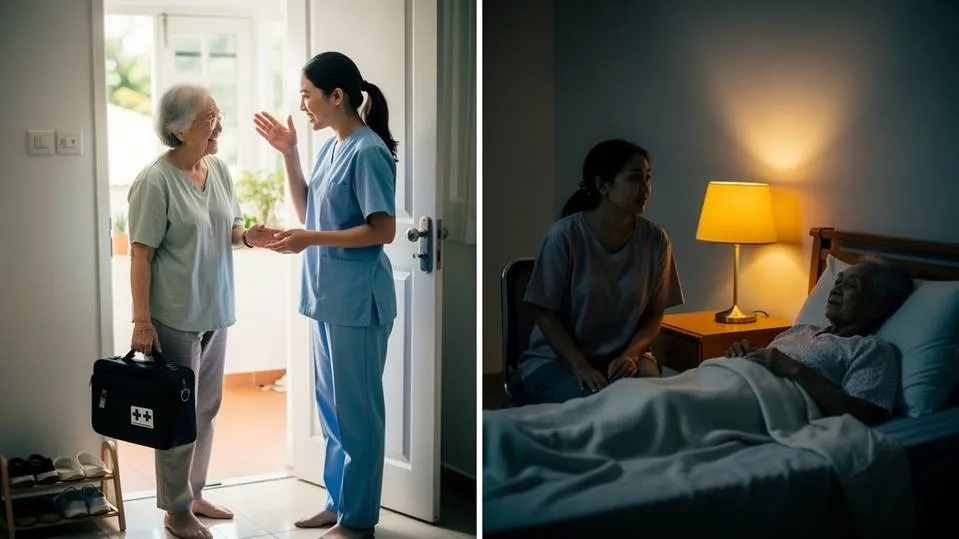
Choosing between a live-in caregiver and part-time care means matching your parent’s daily needs, safety risks, and budget to the right style of support. In short, part-time care suits lighter, focused help, while live-in care suits round-the-clock support and household help.
Part-time care usually involves a local nurse or caregiver visiting for a few hours per visit. This suits seniors who manage most tasks alone but need help with wound care, simple therapy exercises, or bathing on certain days. It also gives family caregivers short breaks when work or stress builds up. The main limit is time. Hourly rates can add up if extra hours are needed, and no one is in the home at night, which is risky for seniors with dementia or frequent toileting needs.
Part-time care can work well when your parent:
· Manages most personal care independently.
· Has low fall risk and sleeps calmly at night.
· Mainly needs help with a few tasks, such as showering or medical procedures.
Live-in care, on the other hand, brings a trained MDW into the home full time. For long-term daily help, this model often works out cheaper per hour than stacking many part-time visits. According to Agency for Integrated Care, many Singapore seniors prefer to age at home rather than in institutions, and live-in helpers make that possible even for those with high support needs.
Live-in care may be more suitable when your parent:
· Needs help with several ADLs every day.
· Wakes often at night, wanders, or has a history of falls.
· Has dementia, complex medical needs, or limited mobility.
Here is a simple comparison to help your family think things through.
| Aspect | Part-Time Care | Live-In Care |
| Hours of support | Fixed visits only | Support across the day and night |
| Cost model | Hourly rates, higher if frequent | Monthly salary and levy |
| Night support | Usually none | Present for night-time needs |
| Household help | Limited or none | Meals, light cleaning, laundry |
| Best suited for | Mostly independent seniors | Seniors needing daily or constant help |
For seniors with dementia, frequent falls, or several medical appointments each month, a live-in caregiver arranged through an experienced agency such as Able Best Maid Agency usually brings far more peace of mind than trying to piece together many short visits.
What Qualifications And Qualities Should You Look For In A Caregiver?

The right caregiver combines practical eldercare skills with a calm, respectful personality that fits your parent. Paper qualifications matter, but behavior under stress often matters even more.
On the technical side, basic medical and safety training is important. Look for helpers who have attended eldercare courses approved by Agency for Integrated Care or similar bodies in their home country. Able Best Maid Agency partners with the Inter Great training center so many candidates arrive with practice in real-life eldercare tasks.
Helpful technical abilities include:
· CPR and first aid, so the helper can respond quickly to breathlessness, choking, or chest discomfort while you wait for an ambulance from Singapore Civil Defence Force.
· Fall prevention knowledge, so the helper knows how to spot tripping hazards, support your parent during transfers, and guide safe use of walking aids or wheelchairs.
· Medication support, so tablets are given at the right times, side effects are noticed early, and missed doses are reported to the family or doctor before they become serious.
· Condition-specific skills, so dementia, stroke, Parkinson’s disease, or diabetes are handled with the right feeding, skin care, and behavior approaches instead of guesswork.
MOM also requires employers to buy medical and personal accident insurance for MDWs and to send them for Six-Monthly Medical Examinations (6ME). According to Ministry of Manpower, this protects both the worker and the household by flagging health issues early. A good agency will guide you through these requirements in plain language.
Soft skills often decide if the placement feels peaceful. Families frequently share that patience, kindness, and a steady mood matter more than perfect English. A helpful tip is to ask scenario questions during interviews, for example, “What would you do if my mother refuses her medication?” or “How would you calm my father if he shouts at night?” The answers show how the person thinks under pressure.
Language fit also matters. Many seniors feel most at ease in Mandarin, Hokkien, Teochew, or Cantonese. Able Best Maid Agency pays close attention to this, shortlisting helpers from Indonesia, the Philippines, and Myanmar whose language skills, or willingness to learn, match the family’s needs.
When possible, video interviews give you a chance to see body language, tone of voice, and how the helper responds when you describe your parent’s behaviour and habits.
How To Match A Caregiver’s Personality To Your Parent’s Needs

Matching a caregiver’s personality to your parent’s needs means aligning temperament, communication style, and physical ability with the senior’s health and habits. A helper who suits one elderly person may frustrate another, even with the same training.
It can help to think about your parent in three areas before you start shortlisting helpers:
· Temperament: Is your parent gentle, anxious, stubborn, very private, or chatty?
· Daily rhythm: Are they an early riser? Do they nap often? Are they calmer after meals?
· Values and habits: Do they prefer quiet, or do they enjoy music, TV, and conversation?
Health conditions shape what kind of temperament works best. A parent with advanced dementia often repeats questions or may accuse others unfairly. This calls for a caregiver who speaks gently, shows little personal ego, and uses redirection instead of argument. For a stroke survivor working hard on rehabilitation at Khoo Teck Puat Hospital, a helper with physical strength and a firm yet kind coaching style helps the person stay motivated.
A reputable agency will not treat every case alike. Able Best Maid Agency starts with a needs assessment that covers medical history, mobility level, mood, sleep patterns, and even past personality traits. That information guides which profiles are suggested rather than sending a random match.
The first weeks with a new helper can feel awkward for everyone. Many parents resist help at first or see it as a loss of independence. To ease this period:
· Introduce the caregiver gradually so early days include short shared tasks, like preparing a simple meal together or going for a supervised walk, instead of handing over full care on day one.
· Frame the helper as extra support so the parent hears that the caregiver is there to help both of you, not to replace the family or control decisions about the home.
· Let your parent keep small choices so they still decide on clothes, meal preferences within medical limits, or daily TV habits, which protects dignity and builds trust with the helper.
Stress does not fall only on seniors. Research Balancing Caregiving and Self-Care: confirms that many family caregivers report significant mental health strain and emotional exhaustion, underscoring the importance of finding a well-matched helper. Post-placement support from Able Best Maid Agency, including mediation and, when needed, orderly replacement, reduces this load so families do not feel trapped if the first match is not right.
“You don’t have to do everything yourself for your love to count.”
— Common reminder from counsellors in caregiver support groups
How A Licensed Maid Agency Makes The Entire Process Easier
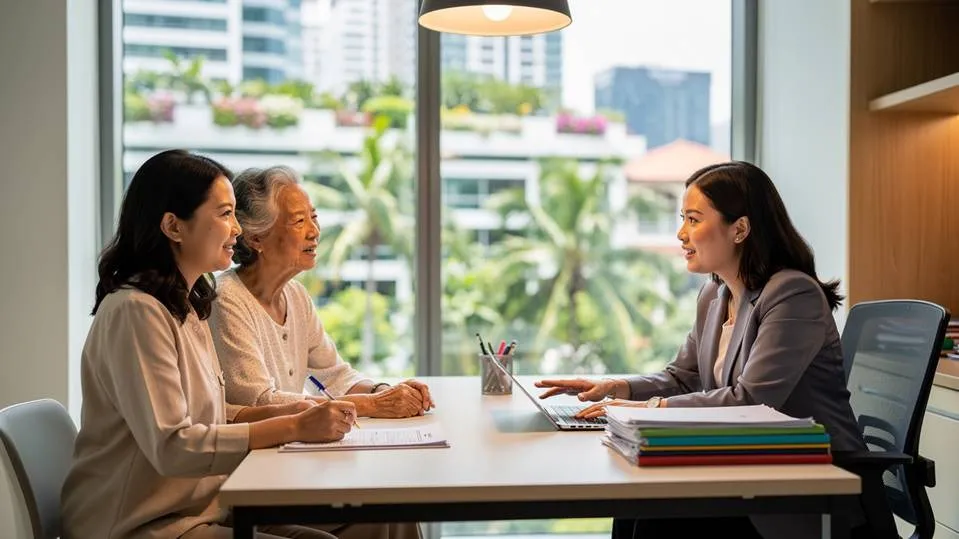
A licensed, MOM-accredited maid agency such as Able Best Maid Agency makes choosing a caregiver easier by handling screening, matching, and MOM requirements in a structured way. That saves families from paperwork stress and lowers the chance of hiring someone who is not ready for eldercare.
For administration, there are several compulsory steps. MOM requires employers to meet age and income rules, complete the Employer Orientation Programme if new to hiring, apply for a Work Permit, and buy a 5,000 dollar security bond for each MDW. According to Ministry of Manpower, employers must also pay a monthly levy, usually 300 dollars, although the MDW Levy Concession can reduce this to 60 dollars when caring for an eligible senior or person with disabilities. Able Best Maid Agency guides families through these steps, including medical and personal accident insurance selection.
Financial support schemes can soften long-term costs. The Home Caregiving Grant provides up to 400 dollars each month to help with care expenses, and the Caregivers Training Grant offers 200 dollars each year for approved courses (Agency for Integrated Care). Able Best Maid Agency advises families on how these schemes, along with the Eldercarer Foreign Domestic Worker Scheme, may fit their situation.
Screening and training sit at the heart of a strong match. Able Best Maid Agency:
· Shortlists helpers from Indonesia, the Philippines, and Myanmar.
· Checks employment history and references.
· Reviews medical reports before presenting profiles.
· Works with the Inter Great training center and similar partners so candidates undergo eldercare-focused preparation such as CPR, fall prevention techniques, vital sign checks, and safe transfer skills.
Support does not stop once the helper moves in. The agency offers counselling and mediation when communication issues arise, and a clear replacement policy if the match does not work — an approach aligned with recommendations in Not Just Visitors Ctacnac 9.16.2025.Pdf on integrating family caregivers into care delivery and design. Recognition such as CASETrust accreditation and inclusion in the Singapore 500 Enterprise Awards reflects long-standing practice rather than short-term marketing claims.
Taking The First Step Toward Peace Of Mind
Taking the first step toward peace of mind starts with accepting that one person cannot do everything alone. When an elderly parent in Singapore begins to need daily help, bringing in a trained caregiver is an act of love, not failure — a perspective reinforced by findings in this Unpaid Caregiving Summary.Pdf on the financial and emotional health of unpaid caregivers who delay seeking professional support.
Talking as a family about current struggles, safety fears, and budget gives a clearer picture of whether part-time or live-in support makes sense. From there, speaking with a team like Able Best Maid Agency helps turn vague worry into a concrete plan built around your parent’s needs and your family’s limits, while staying within MOM rules and insurance requirements.
“It is okay to say, ‘I need help with Mum or Dad.’ Caregiving is a long-distance run, not a sprint.”
Caregiver support worker in Singapore
Conclusion
Choosing the right caregiver for your elderly parent means looking at three things together: what your parent needs help with, what kind of person they feel safe with, and which agency you trust to guide the process. When these pieces line up, home can remain a place of comfort instead of stress.
No family has to figure this out alone. A licensed partner such as Able Best Maid Agency can match skills and personality, handle MOM rules and insurance, and stay involved if adjustments are needed. Help is available, and it is okay to ask for it for your parent’s well-being and for your own.
Frequently Asked Questions
Question 1: What is the difference between a caregiver and a regular maid in Singapore?
A caregiver focuses on eldercare, helping with personal care, mobility, medication, and emotional support, while a regular maid mainly handles household chores. A caregiver is chosen and trained with your parent’s medical and emotional needs in mind, not just cleaning or cooking tasks.
Question 2: How much does it cost to hire a live-in caregiver in Singapore?
The cost includes the helper’s monthly salary, a foreign domestic worker levy of 300 dollars per month, and mandatory insurance, although many families pay a reduced 60 dollar levy through the MDW Levy Concession. There is also a 5,000 dollar security bond. Able Best Maid Agency explains all fees clearly with no hidden charges, so you can plan with confidence.
Question 3: Does my elderly parent qualify for any government grants for hiring a caregiver?
Many seniors qualify for the Home Caregiving Grant, which pays up to 400 dollars each month, and the Caregivers Training Grant, which offers 200 dollars per year for courses. Eligibility depends on how many daily activities your parent needs help with and household income. A licensed agency can guide you through each application and remind you of key documents to prepare.
Question 4: What should I do if the caregiver and my parent do not get along?
Start by talking calmly with both sides, clarifying routines and expectations, and giving some time for adjustment. Many early clashes soften once trust builds. If problems continue, Able Best Maid Agency provides mediation, coaching for the helper, and, if needed, a structured replacement so care is not disrupted.
Question 5: Is it mandatory to hire a caregiver through a maid agency in Singapore?
It is not legally mandatory, but direct hiring means you handle all MOM rules, screening, and paperwork yourself. Working with a licensed, MOM-accredited agency like Able Best Maid Agency reduces legal risk, saves time, and gives access to pre-screened, trained helpers and ongoing support if challenges arise.
