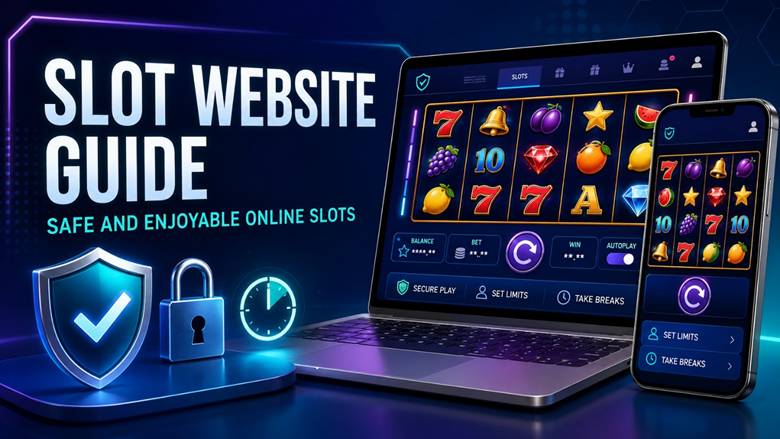
Online slot gaming combines simple controls with a wide variety of themes, reel structures, betting options, and bonus mechanics. A modern เวปสล็อต may provide hundreds of Slots from multiple software developers, along with mobile access, demo games, digital payments, promotions, and account-management tools.
A large game library or attractive welcome offer does not automatically make a platform safe. Before depositing, players need to examine who operates the website, whether its license can be verified, how it protects personal information, and what rules apply to withdrawals. Game authenticity, customer support, and responsible gaming controls are equally important.
This guide explains how online slot platforms operate, how to evaluate their safety, and what players should understand about RTP, volatility, paylines, bonuses, payments, and bankroll management. The objective is not to provide a guaranteed-winning method—no such method exists—but to help eligible adults make better-informed decisions.
What Is a Slot Website?
A Slot Website is an online platform that allows users to access digital slot games through a browser or approved application. Depending on the operator and applicable laws, it may provide free demo games, real-money play, or both.
A complete platform commonly includes:
- Account registration
- A searchable game lobby
- Classic and video Slots
- Multiple software providers
- Deposit and withdrawal services
- Promotions and loyalty rewards
- Game and transaction histories
- Customer support
- Responsible gaming controls
The platform manages the user account and payments, while independent developers may create and host the individual games. Different systems communicate in the background to authorize sessions, record bets, settle results, and update account balances.
Why Choosing the Right Platform Matters
Real-money gaming involves personal data and financial transactions. Selecting an unreliable platform can expose users to delayed withdrawals, hidden bonus conditions, poor security, manipulated account information, or inaccessible customer support.
A suitable Slot Website should provide a secure environment from registration to account closure. It should clearly explain:
- Who operates the service
- Which laws and terms apply
- How deposits are processed
- How withdrawals are approved
- Which documents may be required
- How personal information is used
- How complaints are handled
- How users can limit or stop play
Players should investigate these details before sending money. A payment problem is harder to resolve after funds have already entered an unverified platform.
Checking the Website Address
Fraudulent websites can imitate the appearance of genuine platforms. They may use similar logos, colors, game images, and web addresses.
Before signing in or depositing, users should:
- Check the spelling of the domain
- Confirm that the connection uses HTTPS
- Avoid links from unknown messages
- Use a saved official address where possible
- Examine the contact and company information
- Be cautious of unexpected redirects
- Avoid downloading unverified applications
HTTPS helps encrypt information between the browser and website, but it does not prove that the operator is trustworthy. It is one essential security feature rather than complete evidence of legitimacy.
Reviewing the Operator
A trustworthy platform should identify the company responsible for operating it. This information may appear in the footer, terms, privacy policy, or licensing section.
Important details include:
- Legal company name
- Registered location
- Customer-support channels
- Complaint procedure
- Applicable terms
- Licensing authority where required
If the operator’s identity is missing or inconsistent across different pages, users should avoid depositing until the issue is resolved.
Verifying Licensing Information
Online gambling regulations vary between jurisdictions. Where a license is required, the platform should display information that can be checked through the stated authority.
Players should not rely only on a licensing logo because an image can be copied. A valid license should correspond to the correct operator, website address, and permitted services.
Licensing does not eliminate every risk, but a verifiable regulatory framework can provide standards related to player protection, account funds, game integrity, advertising, and complaints.
Secure Account Registration
Creating an account may require a name, date of birth, mobile number, email address, residential information, and chosen password.
Users should enter accurate information. False or incomplete registration details may cause problems during identity verification or withdrawal.
A secure registration process should include:
- Encrypted data submission
- Clear password requirements
- Email or mobile verification
- Age confirmation
- Privacy-policy access
- Two-step verification where available
Players should use a password that is not shared with email, banking, wallet, or social-media accounts.
Understanding Identity Verification
A real-money platform may need to verify the user’s identity, age, location, and payment ownership. This process is sometimes completed during registration, before the first withdrawal, or when account activity requires additional review.
Common requests may include:
- Proof of identity
- Proof of address
- Payment-method ownership
- A photograph or verification check
Before submitting documents, users should confirm that the platform is legitimate and that the upload process is secure.
A transparent verification policy should explain:
- Which documents are accepted
- Why they are required
- How data is protected
- How long the review takes
- Why a document may be rejected
- Whether information is shared with service providers
Sensitive documents should not be sent to unofficial social-media accounts or unknown messaging contacts.
Exploring the Game Lobby
A well-organized game lobby makes it easier to browse Slots without unnecessary confusion. Platforms may group titles by provider, theme, mechanics, popularity, release date, or volatility.
Common categories include:
- Classic slots
- Video slots
- Jackpot games
- Cascading-reel games
- Cluster-pay games
- Ways-to-win slots
- Free-spin games
- Demo games
- New releases
- Recently played titles
Popularity does not mean that a game pays more frequently or provides better odds. A title may be popular because of its graphics, theme, mobile design, or bonus features.
Classic Slots
Classic games are inspired by mechanical slot machines. They often use three reels and familiar symbols such as fruits, bells, bars, stars, and sevens.
These Slots commonly have straightforward rules and fewer special features. Updated digital versions may include wilds, scatters, multipliers, respins, or several paylines.
Their simple appearance does not make them predictable. Classic games can still have a significant house advantage and high volatility.
Video Slots
Video Slots generally use five or more reels and provide animated themes, sound effects, multiple paylines, and interactive features.
Themes may include:
- Fantasy
- Mythology
- Wildlife
- Adventure
- History
- Travel
- Food
- Space
- Treasure
Players should read the game rules because visual presentation does not reveal its mathematical structure. Two games with similar themes can have different RTP values, volatility levels, and bonus conditions.
Ways-to-Win Slots
Ways-to-win games may reward matching symbols on adjacent reels rather than requiring them to appear on fixed paylines.
Some titles use a fixed number of ways, while others change the reel height and number of possible combinations during each spin.
A game advertising thousands of ways to win does not guarantee profitable results. The value and frequency of symbols, total wager, RTP, and volatility continue to matter.
Cascading Slots
In cascading games, symbols involved in a winning combination disappear and new symbols enter the empty positions. This can create another combination without requiring a new paid spin.
Certain titles apply an increasing multiplier during consecutive cascades. The sequence ends when the new symbols do not produce another win.
Cascades add entertainment and movement, but they cannot guarantee several rewards from every round.
Cluster-Pay Games
Cluster-pay Slots use groups of matching symbols instead of conventional paylines. Symbols may need to connect horizontally, vertically, or through other patterns defined by the game.
The rules should explain:
- Minimum cluster size
- Valid connection directions
- Symbol values
- Cascade behavior
- Bonus activation
- Maximum possible reward
Demo mode can be useful for learning these less traditional systems.
Jackpot Slots
Jackpot games may offer fixed, local, or progressive prizes. A progressive jackpot can grow through qualifying bets until the prize is awarded.
Players should check:
- How the jackpot is triggered
- Whether a minimum bet is required
- Which bets qualify
- Whether the prize is fixed or progressive
- The maximum payout rules
- Whether bonus funds can be used
A large jackpot can have a very low probability of being won. It should never encourage users to exceed their budgets.
Checking the Game Provider
A reliable Slot Website should identify the developer behind each title. The game interface, paytable, and provider branding should remain consistent.
Users should be cautious if:
- Provider names are missing
- Games cannot display their rules
- Betting limits change unexpectedly
- Balances are inconsistent
- Round histories are unavailable
- Interfaces appear altered or incomplete
Provider recognition alone does not establish the legitimacy of the operator. Both the game and the platform need to be evaluated.
Understanding Reels, Rows and Paylines
Reels are the vertical columns that display symbols. Rows are the visible positions on those reels. A common arrangement uses five reels and three rows, although many other layouts exist.
A payline is a pattern where matching symbols may create a reward. A game can have:
- One fixed payline
- Several fixed paylines
- Adjustable paylines
- Hundreds of paylines
- Ways-to-win mechanics
- Cluster-pay systems
- Pay-anywhere rules
The total cost of a spin should always be visible. Players must understand whether the displayed value represents the entire wager, the bet per line, the number of coins, or the value of each coin.
Reading the Paytable
The paytable is the main source of information about a slot’s mechanics. It explains what each symbol means and how rewards are calculated.
A complete paytable may include:
- Regular symbol values
- Wild behavior
- Scatter conditions
- Winning patterns
- Free-spin rules
- Multiplier details
- Bonus activation
- Betting limits
- Maximum possible payout
- Special restrictions
Players should read it before choosing a bet. A game’s animations show that an event occurred, but the paytable explains why it happened.
Understanding RTP
RTP means Return to Player. It is a theoretical percentage describing how much of the total money wagered in a game may be returned over a very large number of rounds.
For example, a game with a theoretical RTP of 96% is designed to return an average of 96 units for every 100 units wagered across its complete mathematical cycle.
This does not mean every player will recover 96% of a deposit. A short session can result in a profit, a loss, or approximately the starting balance.
RTP is:
- A long-term theoretical calculation
- Not a prediction for one session
- Not a guaranteed personal return
- Potentially different across game versions
- Unable to remove the house advantage
Users should check the information for the exact version provided by the platform.
Understanding Volatility
Volatility describes the general payout pattern of a game.
Low Volatility
Low-volatility Slots tend to provide smaller rewards more frequently. They may create less dramatic balance movement, although losses remain possible.
Medium Volatility
Medium-volatility titles generally balance reward frequency and potential size.
High Volatility
High-volatility games may produce rewards less frequently while offering the possibility of larger individual payouts. Long losing sequences can occur.
Volatility does not reveal when a win will happen. It helps players understand how rapidly a balance may rise or fall.
Wild Symbols
Wilds typically substitute for selected regular symbols to help form winning combinations.
Common variations include:
- Standard wilds
- Expanding wilds
- Sticky wilds
- Moving wilds
- Stacked wilds
- Multiplier wilds
- Random wilds
A wild may not replace a scatter, bonus symbol, or jackpot icon. The exact rules should appear in the paytable.
Scatter Symbols
Scatters often activate free spins or bonus features. Unlike standard symbols, they may not need to appear on an active payline.
A game may:
- Reward two or more scatters
- Require three to trigger free spins
- Award additional spins for four or five
- Use scatters to unlock expanding reels
- Allow feature retriggers
Each game has its own conditions. Players should not assume that scatter rules are identical across all Slots.
Free Spins and Bonus Rounds
Free-spin features provide a set of rounds without charging the standard base-game wager for every spin. They may include enhanced wilds, multipliers, expanded reels, symbol collections, or retriggers.
Other bonus rounds can involve:
- Selecting hidden prizes
- Collecting special symbols
- Advancing through levels
- Activating mystery symbols
- Unlocking reel modifiers
- Increasing multipliers
A bonus round does not guarantee a profitable session. The return can be lower than the amount spent before the feature appeared.
Feature-Buy Options
Some games allow eligible users to pay a multiple of the standard wager to access a bonus feature immediately.
The purchase price can be significantly higher than a normal spin. Before using such an option, players should check:
- Total feature price
- Base bet
- Feature volatility
- Maximum possible payout
- Regional availability
- Bonus restrictions
A purchased feature can return less than its cost. It should never be used to recover previous losses.
Using Demo Mode
Demo Slots allow users to play with virtual credits. They are helpful for learning how a title operates before risking real money.
Players can use demo mode to explore:
- Bet controls
- Reel structure
- Paylines
- Symbol values
- Wilds and scatters
- Bonus mechanics
- Game pace
- Mobile performance
Virtual winnings generally have no cash value and cannot be withdrawn. Demo results also cannot predict real-money outcomes.
A large virtual win does not indicate that the game will provide a similar result after a deposit.
How Game Outcomes Work
Legitimate online Slots are designed to produce unpredictable results according to their underlying mathematical rules. Previous rounds do not guarantee what will happen next.
Players cannot reliably control results by:
- Pressing the button at a certain time
- Stopping the reels manually
- Changing the bet after a loss
- Playing during a particular hour
- Following a visual symbol pattern
- Switching payment methods
The belief that a win must follow several losses is known as the gambler’s fallacy. A losing sequence does not make the next spin more likely to produce a win.
Depositing Safely
Deposits should always begin through the official cashier inside the registered account.
A typical process includes:
- Sign in through the verified website address.
- Open the deposit section.
- Select an available payment method.
- Review the minimum and maximum limits.
- Check fees and currency conversion.
- Enter an affordable amount.
- Confirm the transaction securely.
- Save the payment reference.
- Check the updated balance.
If the balance does not update, contact official customer support before repeating the payment.
Users should never share a password, wallet PIN, card security code, or one-time verification code.
Reviewing Deposit Terms
Before making a payment, check:
- Minimum deposit
- Maximum deposit
- Supported currencies
- Processing time
- Transaction fees
- Eligible wallet or bank accounts
- Bonus qualification
- Payment-provider limits
A fast deposit system does not prove that withdrawals will be equally fast. The two policies must be examined separately.
Understanding Withdrawals
A withdrawal transfers eligible money from the gaming balance to an approved payment method.
The process may require:
- Identity verification
- Payment ownership confirmation
- Bonus-condition review
- Security screening
- Transaction approval
- Compliance with withdrawal limits
Players should check these details before depositing:
- Minimum withdrawal
- Maximum withdrawal
- Daily and monthly limits
- Available withdrawal methods
- Operator processing time
- Payment-provider processing time
- Withdrawal fees
- Required documents
A reliable Slot Website should not add unexpected conditions after the request has been submitted.
Reasons a Withdrawal May Be Delayed
Common reasons include:
- Incomplete verification
- Incorrect account information
- Use of another person’s payment method
- Unfinished wagering requirements
- Wallet or bank maintenance
- Security reviews
- Transaction-limit checks
- Weekends or holidays
A legitimate review should follow the published rules. Repeated cancellations without a specific reason or demands for additional deposits are warning signs.
Evaluating Bonuses
A platform may advertise welcome bonuses, deposit matches, free spins, cashback, or loyalty rewards.
Important conditions include:
- Minimum qualifying deposit
- Wagering requirement
- Eligible games
- Contribution rates
- Maximum bet
- Promotion expiration
- Maximum convertible winnings
- Restricted payment methods
- Withdrawal limitations
For example, a bonus of 100 units with a 30-times wagering requirement could require 3,000 units in qualifying bets.
A smaller promotion with simple conditions may be more practical than a large bonus with restrictive rules.
Managing a Slot Bankroll
A bankroll is money reserved exclusively for gaming entertainment. It should be separate from funds required for essential responsibilities.
A responsible plan should include:
- Maximum total deposit
- Session budget
- Maximum bet
- Loss limit
- Time limit
- No borrowing
- No loss chasing
Money needed for housing, food, healthcare, education, transportation, debt payments, savings, or family support should never be used for Slots.
No bankroll method can guarantee a profit. Its purpose is to maintain financial control.
Choosing a Suitable Bet
The bet should be small enough to fit comfortably within the session budget. A large wager can consume a balance rapidly.
For example, a budget of 20 units provides only ten rounds at 2 units per spin if none returns a reward. At 0.20 units per spin, the same budget supports more rounds.
More rounds do not guarantee a positive outcome, but a smaller bet can reduce the rate at which the budget is exposed.
Players should not increase the bet solely because several losses have occurred.
Avoiding Repeated Deposits
A small payment may seem harmless, but repeated deposits can create a significant total loss.
Players should track:
- Number of deposits
- Total amount deposited
- Withdrawals received
- Net result
- Transaction fees
- Time spent playing
Once the predetermined deposit or loss limit is reached, the session should stop. Another transfer should not be used to recover previous losses.
Recognizing Loss Chasing
Loss chasing occurs when a player continues gambling or increases wagers in an attempt to recover lost money.
This behavior is risky because:
- Every new spin remains uncertain.
- Previous losses do not create a guaranteed future win.
- Larger wagers increase financial exposure.
- Emotional decisions weaken personal limits.
- Borrowing introduces additional consequences.
Stopping protects the remaining funds. Continuing does not guarantee recovery.
Mobile Gaming Security
Mobile devices often contain the gaming account, email, wallet, payment applications, and verification messages. Protecting the device is essential.
Users should:
- Enable a secure screen lock
- Keep the operating system updated
- Use a unique password
- Activate two-step verification
- Avoid public Wi-Fi for payments
- Download only verified applications
- Never share an OTP
- Log out after playing
- Review transaction notifications
If a device is lost, the user should secure all connected accounts immediately.
Customer Support Standards
Reliable support should be available through clearly published channels. It may include live chat, email, messaging, or a help center.
Good support should:
- Operate during stated hours
- Answer specific questions
- Follow published terms
- Protect personal information
- Provide a case reference
- Explain expected resolution times
Support representatives should never request a full account password, wallet PIN, or OTP.
Testing support with a simple withdrawal question before depositing can reveal how clearly the team communicates.
Keeping Account Records
Players should save records related to deposits, withdrawals, bonuses, and disputed rounds.
Useful details include:
- Date and time
- Transaction amount
- Payment method
- Reference number
- Game title
- Round identifier
- Support case number
- Current status
These records can support investigations and reveal total spending over time.
The account history should also be reviewed regularly for unknown transactions or balance changes.
Responsible Gaming Tools
A secure Slot Website should offer tools that help users control or stop their activity.
These may include:
- Deposit limits
- Loss limits
- Wagering limits
- Session reminders
- Cooling-off periods
- Temporary account suspension
- Self-exclusion
- Transaction-history access
Players should establish limits before beginning, not only after experiencing a problem.
If gaming affects finances, sleep, work, education, relationships, or emotional health, stopping and seeking appropriate assistance is essential.
Warning Signs of Problematic Gaming
Potential signs include:
- Spending more than planned
- Hiding gaming activity
- Borrowing money to play
- Chasing losses
- Missing work or study
- Feeling anxious when unable to play
- Repeatedly breaking personal limits
- Using essential funds
- Viewing Slots as a source of income
Recognizing these patterns early can prevent greater financial and personal harm.
Common Slot Myths
A Game Is Due to Pay
Previous losses do not guarantee an upcoming win.
Certain Times Produce Better Results
There is no reliable hour that guarantees favorable outcomes.
A Payment Method Changes the Odds
Payment services move funds. They do not change RTP or game results.
Demo Wins Predict Real Wins
Virtual results cannot forecast future real-money outcomes.
A Large Deposit Creates Better Chances
A larger balance only provides more money to wager. It does not guarantee better results.
A Strategy Can Guarantee Profit
No betting pattern can eliminate uncertainty or the house advantage.
Legal and Age Requirements
Online gambling laws differ between countries and regions. Access to a website does not automatically mean participation is legal.
Before creating an account, users should verify:
- The legal gambling age
- Local online gaming restrictions
- Operator authorization
- Payment regulations
- Tax obligations
- Regional game limitations
Minors must never access real-money slot platforms. Eligible adults remain responsible for following the laws that apply to them.
Comparing Slot Websites
A structured comparison helps users look beyond promotions.
| Category | What to Review |
| Operator | Company name and contact information |
| Licensing | Current and independently verifiable |
| Slots | Authentic providers and accessible rules |
| Security | Encryption and account protection |
| Deposits | Methods, limits, fees and timing |
| Withdrawals | Requirements, limits and processing |
| Bonuses | Wagering and withdrawal conditions |
| Mobile access | Responsive and stable performance |
| Support | Clear and professional assistance |
| Responsible gaming | Limits, breaks and self-exclusion |
The platform with the largest bonus or most games is not automatically the best. Transparency, security, and dependable withdrawals matter more.
Questions to Ask Before Playing
Before depositing, users should answer these questions:
- Is the operator clearly identified?
- Can the license be verified?
- Are the game providers displayed?
- Can the paytables be opened?
- Are betting limits clear?
- Is RTP information available?
- Are deposit fees disclosed?
- What is the minimum withdrawal?
- How long do withdrawals take?
- Is verification explained?
- Do bonuses affect withdrawals?
- Are responsible gaming controls available?
- Can the entire deposit be lost without hardship?
If essential information remains unclear, the user should not deposit.
A Safer Session Routine
Before playing:
- Set an affordable budget.
- Choose a maximum bet.
- Review the paytable.
- Set a time limit.
- Decide whether to decline bonuses.
- Confirm the stop point.
During the session:
- Monitor the total balance.
- Avoid emotional bet increases.
- Take regular breaks.
- Do not make repeated deposits.
- Stop when the limit is reached.
After the session:
- Log out.
- Review the transaction history.
- Record the financial result.
- Avoid immediately chasing losses.
- Secure the payment device.
This routine cannot guarantee winnings, but it can support better control.
Frequently Asked Questions
How Can I Identify a Safe Slot Website?
Check the operator, license, security, provider information, payment rules, withdrawal terms, support quality, and responsible gaming features.
Can I Test Slots Without Depositing?
Many platforms provide demo mode with virtual credits. Demo winnings usually cannot be withdrawn.
Does Higher RTP Guarantee a Win?
No. RTP is a long-term theoretical percentage and cannot predict one player’s session.
Why Is My Withdrawal Taking Longer Than My Deposit?
Withdrawals may require identity, payment, security, and bonus checks before approval.
Are Welcome Bonuses Free Money?
No. Bonuses often include wagering, expiration, maximum-bet, game, and withdrawal conditions.
Can I Guarantee Profit With a Slot Strategy?
No. Slot outcomes remain uncertain, and no system guarantees profit.
Final Thoughts
Choosing the right Slot Website requires more than comparing game numbers, welcome bonuses, or deposit speed. A dependable platform should identify its operator, provide verifiable licensing information where required, protect account data, display authentic Slots, and explain every payment condition clearly.
Players should study RTP, volatility, paylines, special symbols, and bonus mechanics before using real money. Demo mode can help users understand unfamiliar games, but virtual results cannot predict real-money outcomes.
Deposits should come only from an affordable entertainment budget. Strict spending and time limits, secure account practices, complete transaction records, and a willingness to stop are essential parts of responsible gaming.
No สล๋อด Website, bonus, payment method, or betting pattern can guarantee profit. Eligible adults who participate should treat Slots exclusively as entertainment and prioritize financial safety, legal compliance, and personal well-being throughout the experience.
